After finally getting off the boat, we were still not in Tombouctou, but rather in the village of Kabara, about 20 kilometers from Tombouctou. Apparently there used to exist an off-shoot of the Niger river that ran straight from Tombouctou into the Niger, but it has since dried up. It took us an hour or so of haggling, but we got transport to Tombouctou itself. Three full grown adults, two fairly large backpacks, and one motorcycle. I’m not sure how we managed to fit, but we did. We arrived in Tombouctou (finally) and found a place to stay. As soon as we checked in, a city guide greeted us with “Welcome to the middle of nowhere.”
For the next few days we explored “the middle of nowhere” and the city that is Tombouctou. Tombouctou is often associated with the furthest corners of the globe, and rightfully so. The city sits on the cusp of the world’s largest desert and is hot and dry all the time. Despite the streets of sand, the mud buildings, and the remoteness of the place, it boasts a history that is second to none in terms of historical and geographic significance. Well before Europeans had stepped foot in Tombouctou or had even sailed to what would become known as the Gold or Ivory Coasts, Tombouctou was a bustling metropolis that housed one of the largest, if not the single biggest, collection of Islamic texts in the world and was home to a university population of more than 25,000 students. The importance of Tombouctou was very much derived from its geographic location on the northern most bend of the Niger River and the northern most point on the southern border of the Sahara to the Sahel. What that means is that it was the most centralized location for trade. Muslim traders from the Middle-east could reach the city and transport goods both up and down the Niger River. Therefore, the city began first as a trading center, but soon became an academic institution in and of itself as well. A Malian proverb states that “Salt comes from the north, gold from the south, but the word of God and the treasures of Wisdom come from Tombouctou.” Today, the city is but a shadow of the grandeur of what it once was. The ominous Sahara Desert has threatened to over run the city with sand and UNESCO has worked during the past decade to help save the city, its ancient books, and its history.
As we explored the city we were hounded by locals (the Tuareg) trying to sell us cheap jewelry and guided tours. Despite the hawks and the oppressive heat (it can easily, and often does, reach 115 degrees) the city was neat to explore. Tombouctou is home to three of the oldest mosques in West Africa and most of the other buildings are made in a traditional style from mud. Many of the doors of the houses are decorated with carvings and silver and are very impressive. The market was interesting and worth seeing as well as it was filled with slabs of salt from the desert. Quite possibly the most entertaining of our time in Tombouctou was a camel excursion out into the Sahara. Just before sunset one evening we dickered with a guide and he finally agreed to take us into the desert on camels. The trip was awesome. It was my first time on a camel and my first time into the Sahara, plus the sunset was beautiful. We walked out for a while with one of the Tuareg leading the camels and then stopped for a short break (when we stopped the Tuareg, as usual, tried to sell us jewelry). After playing in the sand and taking pictures, we got back on the camels and rode back in the dusk to Tombouctou. On the return trip I talked the guide into giving me the reigns and letting me “drive” the camel myself. I had a blast.
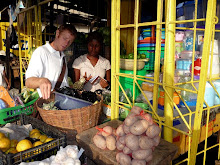
When we returned to Tombouctou, we went out in search of dinner and found a little street vendor who sold a number of different dishes. “Fatima” or “Fati”, as everyone called her, made us some noodles and red sauce, French fries (“Fati’s Frites”) and the best salad I have ever eaten in all of West Africa, restaurants included. After eating a very nice dinner, we did some wash one more time, packed our bags, and went to bed early as the adventure would continue the next morning at 4am when we got set to make the longest trek ever back to Accra.

Tuesday, May 5, 2009

Tuesday, April 28, 2009
Mali Photos One...
A group of kids that I ran into in Sevare, a town next to Mopti the day before getting on the river. They were cool and had, next to their house, an entire barnyard of animals: goats, chickens, bunnies, donkies, even a cow. Whatever face I made, they made, except for the Donkey. In Bobo we went exploring and found an old mosque in the city center Outside were many begger children and people praying. This old man is blind and the children take turns leading him around so that he can beg. When the camera came out they were all smiles.

After a few days on the river. We had just gotten stuck at twilight and the river and sky were beautiful. Just as we were taking this picture we realized that there was a hippo about 200 yards from the boat. Some small fishing boat was passing and so I gave him a few coins to take me with a camera over near the hippo. However, the hippo was less than interested in being photgraphed and I really did not get many good shots. I can say that I was withing 50 yards of a hippo in the wild.

The next day we saw more hippos, and the net day, and the next day. All in all we probably saw close to 50 of them. Most of the time they are in the water though, not once did we see them entirley out. At one point one of them yawned or growled or barked or whatever hippos do, but it raised its whole head out of the water and opened its mouth. I have never seen a bigger, scarier looking mouth.
 As we passed these sheep they all were being herded by their shepard down to the water. Instead of all piling in, they very orderly made a straight line and all bent down to get water. It almost looks as if they are all praying.

 In Bobo we went exploring and found an old mosque in the city center Outside were many begger children and people praying. This old man is blind and the children take turns leading him around so that he can beg. When the camera came out they were all smiles.

After a few days on the river. We had just gotten stuck at twilight and the river and sky were beautiful. Just as we were taking this picture we realized that there was a hippo about 200 yards from the boat. Some small fishing boat was passing and so I gave him a few coins to take me with a camera over near the hippo. However, the hippo was less than interested in being photgraphed and I really did not get many good shots. I can say that I was withing 50 yards of a hippo in the wild.

The next day we saw more hippos, and the net day, and the next day. All in all we probably saw close to 50 of them. Most of the time they are in the water though, not once did we see them entirley out. At one point one of them yawned or growled or barked or whatever hippos do, but it raised its whole head out of the water and opened its mouth. I have never seen a bigger, scarier looking mouth.
 As we passed these sheep they all were being herded by their shepard down to the water. Instead of all piling in, they very orderly made a straight line and all bent down to get water. It almost looks as if they are all praying.

Mali Photos Two...
These two women were outside of the Mosque in Bobo, the one on the left wanted me to take her picture, the one on the right had absolutley no interest in having her picture taken. I gave both of them a small coin and asked again. She still said no. I gave here another small coin, she said no. I gave her one more small coin. No. She ended up allowing me to take this picture, but I think that she pretty much outsmarted me.
 One day on the boat down the Niger, we randomly stopped and picked up this women and her baby. Her head dress and jewelry were beautiful and traditional of Malian society. The orangish-yellowish larger beads are amber.
 This women was also outside of the Mosque in bobo and was estatic to have her picture taken. I am not sure if she could see me or not, but she just laughed and laughed and laughed.

These were twin girls outside of the mosque in Bobo and were just about as cute as can be. They did not really know what was going on and why some white people were making them stand in a spot to take a picture of them.
 This is a hand made sailboat floating up the Niger River. I am pretty sure that the sail itself is made from old flour bags that have been stitched together. These boats are really something to see on the river. The river and the surrounding landscape is so flat that the bulbous sails stand out very proudly against everything else.
 This is a hand made sailboat floating up the Niger River. I am pretty sure that the sail itself is made from old flour bags that have been stitched together. These boats are really something to see on the river. The river and the surrounding landscape is so flat that the bulbous sails stand out very proudly against everything else.

Mali Photos Three...
Looking under the canopy where I lived for 8 days and 7 nights. Actually, they added another layer of millet sacks so when you sat under the hut you had to bend your neck so that your head would not hit the roof. It was a cramped to say the least and millet sacks do not make the best of mattresses.

Same kids that have the barnyard next to their house, they were cool and liked hanging out with the Americans.


Same kids that have the barnyard next to their house, they were cool and liked hanging out with the Americans.

Mousha after having done some of the wash on the boat, setting it out in the sun to dry. Wet clothes dry in a matter of minutes in Mali because it is so hot and the air is so dry.


The first full day in Tombouctou we woke up and walked around the city. The light was beautiful and the city was amazing, all over the city there are these type of doors that are intimidating and captivating at the same time. The streets are all sand and the bricks buildings are all handmade and old. A historic city to say the least.


In the market in Tombouctou there are these slabs of salt that have been carried down by camel for hundreds of miles to be sold and distrbuted to points further away. One of the places I ate in Tombouctou put a salt shaker on the table with the food. I read the bottle an learned that the salt was imported from France.

Mali Photos Four...
This is freeze frame taken from the beginning of a short video. I am just about ready to jump and slide down the sand dune. It did not work out as well as I may have hoped, but I still felt like a kid playing in a sand box...the worlds biggest sand box. Later, I got to watch the sunset over the Sahara Desert.
This is the first time that I have ever been on a Camel. Camels are dinosaurs that somehow survived until now. They are huge and there is nothing else on earth that I have ever seen that compares to them. On the way out into the Sahara a Tuareg guy led the camel for me, but on the way back I talked him into letting me "drive." 'Abduza' and I got along very well and he did not make any sudden movements and responded like a sportscar, infact he and I (more he) led the caravan the rest of the way back to Tombouctou.

While walking around Tombouctou inthe morning the lighting was perfect for taking pictures. The kid in the background, whose shirt perfectly matchs the tarp on the truck. Walked out towards us, saw us, and promptly turned back around.

Tombouctou has three of the oldest Mosques in all of West Africa. They are all made of mostly mud and are not open to anyone that is not Muslim. At one point all of the Mosques were also universities that studied Islamic texts, namley the Koran. Tombouctou, hundreds of years ago, boasted a student population of more than 25,000 and one of the largest, if not the largest, collection of Islamic texts in the world.

Mali Photos Five...
These were women in Sevare, Mali that were just walking by us, persumably on their way home from selling in the market (only women sell in the markets and most of them have huge bowls or basins like the ones on their heads). They were all very nice and the colors and variety of their cloth was quite impressive. Also, if you notice the area around lips ofthe women has been colored black. I only saw this Mali on about half of the women. I do not know why they do it, but it looks like then have been eating charcoal.  On the trek back from Tombouctou, we stopped to fix a flat tire in the middle of Dogone country. In the middle of the Sahel there are these huge rock formations that, partially do to the uniform flatness of the surronding landscape, are very not only monstrous, but also ominous.

This is actually in Mamobi, Ghana (my neighborhood in Accra). While walking around I talked to an old women and noticed that there were kittens running around that could not have been more than a few weeks old. I am a sucker for kittens so I ended up playing with them for at least half an hour.

This is an example of how they fish on The Niger River. He takes this huge net wades into the water and then throw it out in hopes of trapping the fish under the net. It is really neat to see them just as they throw the net into the river.
 Andrea and Galicka under the canopy on the boat. It took Galicka a little time to warm up to me, but within a few hours her and Andrea were life long best friends. It was charming to see two people from vastly different countries and cultures, with different ages and traditions, religions, languages, and skin color to be able to connect so easily and deeply.

 On the trek back from Tombouctou, we stopped to fix a flat tire in the middle of Dogone country. In the middle of the Sahel there are these huge rock formations that, partially do to the uniform flatness of the surronding landscape, are very not only monstrous, but also ominous.

This is actually in Mamobi, Ghana (my neighborhood in Accra). While walking around I talked to an old women and noticed that there were kittens running around that could not have been more than a few weeks old. I am a sucker for kittens so I ended up playing with them for at least half an hour.

This is an example of how they fish on The Niger River. He takes this huge net wades into the water and then throw it out in hopes of trapping the fish under the net. It is really neat to see them just as they throw the net into the river.
 Andrea and Galicka under the canopy on the boat. It took Galicka a little time to warm up to me, but within a few hours her and Andrea were life long best friends. It was charming to see two people from vastly different countries and cultures, with different ages and traditions, religions, languages, and skin color to be able to connect so easily and deeply.

Mali Photos Six...
These are a group of kids that we met on the Niger when we stopped to take on more sacks of Millet. They were all full of energy and slowly creptup to the boat asking for "cada" (money). I told them that did not have any money but gave them candy, which to them, as kids, is probably more valuable.

The same group of kids on the Niger. We played a game that I would put my hand out and they would try to give me five quickly if they were too slow I would grab onto their hand pull them out of the water and throw them back in. They loverd it. I loved it.

Galicka and I eating mangos. Mangos grow wild in West Africa so they are all over the place and just as I left on the trip they started to ripen. For three weeks I ate at least a mango or two each day. The sweetest and most delicious mangos I have ever eaten.

Galicka and Andrea, best friends. Everything that Andera did Galicka was interested in. From drawing to reading to eating.
 Mousha cooking dinner. He cooked everything so that it was edible but the animal fat and the Niger river water that he used in cooking started to get to me after a few days. I cooked with him once, but just could not stomach it enough to do it again.

Subscribe to:
Posts (Atom)