Tuesday, July 14, 2009

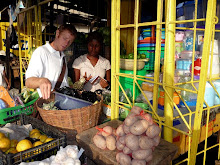
Mamobi Mary, the Banana Lady...


As my time here is Ghana is starting to come to a close, I find myself philosophically looking at what mark I have left on Ghana, and what mark Ghana has left on me. I know that many of the students here are wonderful; funny, energetic, creative, and they have certainly left an impression on me that will last for years to come. It is my hope as a teacher, that I have made a positive impact on them that will not be too quickly forgotten. As much as my year here has been about teaching, education, and students, I believe that it has been about something greater still.

The whole mission of the Fulbright program is to encourage and promote "mutual understanding between the people of the United States and the people of other countries of the world." This being stated, I have also found it to be true. My time here has been full of amazing adventures and experiences that will leave me with a lifetime of stories. None of those stories, adventures, or experiences would be possible if not for the connections made with other individuals. In my own thoughts on the topic, I keep coming back to the word “connections.” I am not sure how exactly to explain it, but here is a story that may help paint a picture.

One of the most rewarding experiences that I have had in Ghana thus far has been the connection I have made and friendship developed with the “Banana Lady.” Her name is Mary, but I rarely use it as I learned it 7 months after meeting her. Outside of Accra Girls’ School, at the entrance to Mamobi (a poor, but respectable, neighborhood) there is a women who sells bananas, oranges, pineapples, papayas, and groundnuts (peanuts). All of the fruit is beautiful. Just across the street, further away from the school, “Banana Lady” sells the exact same fruits for the same prices. When I first arrived here, I bought bananas and things from the lady just outside of the school, but I never made any connection with her and our dealings were always very business-like. One day I happened to walk by “Banana Lady”, bought some groundnuts and she was nice and we connected. Since then I will only buy from her. She is great and I love her. At lunch during the week I will go and sit with her on her bench, have a few bananas and some groundnuts, and just talk with her. Every time I travel she gives me a jar of groundnuts to take with me and she will always “dash” (give) me extra fruit. Most of the time she does not even charge me- a women who may make all of 4 or 5 dollars in a day will just give me fruit for free, knowing full well that I can pay easily. Sometimes I will take what she gives me, but then the next time, I will give her twice as much money as needed and tell her I don’t want change. I have introduced her to most of the other Fulbrighters and they will, on occasion, come and visit her. When I bought my moped, I stopped by and gave her a ride. Most Ghanaians that I have met want something, but she is just as friendly and as genuine of a person as I have ever met.

Now that my sister is here, each day we will go running together and finish at the Banana Lady’s stand. Often times the highlight of my day is the hour or so after my run. I usually feel pretty good and I sit with Mamobi Mary, the Banana Lady and my sister on the corner where she sells. Next to her, is a lady who sells corn each night and Evelyn, a 14 or 15 year old girl who de-tassels the corn for her. For that hour at dusk, my sister and I will help Evelyn de-tassel corn and talk about what she learned in school that day and what she wants to be when she grows up. We will play with the children that always seem to be at the corner; Patrick, Monica, and Regina. I tickle Regina until she smiles and yells, swing Monica until she is dizzy, and tease Patrick about being a Kotoko (a local soccer team that he hates) fan until he smiles and just shakes his head at me. The corn lady has taken to trying to give my sister and I each an ear of corn each night. She is quiet, but just as sweet as Mamobi Mary. Mary herself will sit and watch out for us and periodically yell to me that a passing trotro is going to Nima (a ghetto in Accra that is well-known to be full of thieves and criminals). She yells “Nima boy, this is your trotro.” I call her a “Nima Girl” and she says “No, no, no; Mamobi Girl” and then laughs like only Mary can laugh. All the while the pure water girls are dancing and chasing after one another and from time to time they yell to me “Hey, Nima Boy.” Each day before we go she tries to give my sister a mango, bananas, pineapple, or groundnuts. Never will she give me something, but always to Susan, knowing full well that I will probably be the one that ends up eating most of it.

However, the connection is stronger than just an hour or so each night. Whenever I go out to buy food on the street, I will always buy twice as much and split it with Mary. Usually, I will sit at her stand and eat with her while she sells bananas. In return, Mary has given me much more. On multiple occasions she has made dinner for me; when she goes to market to buy her fruits, she will always buy an avocado or two just for me, and when I finish running she is there to hand me a sachet of cold water. Before President Obama visited Ghana, I walked out to see Mary wearing a polo that had a picture of President Obama on the front and President Atta Mills of Ghana on the back. She was so very proud of it and when I told her it was very cool, she presented me with a one of my own. It is a second hand, stained, XXL, white polo with the two men’s pictures; a gift that I will treasure forever. That same day, in the evening, she, without me knowing, gave my sister a set of earrings and a matching necklace. In terms of Ghanaian standards, the jewelry was expensive. There was no talking Mary into taking any money for them. Instead, she did except the earrings that my sister was wearing in return. Each night she continues to try and give my sister some fruit or something out of the goodness of her heart. So many Ghanaians see Americans and want money or a visa, but Mary has never asked for either or for anything.

I have greatly enjoyed my time here in Ghana and in West Africa. The most rewarding experiences that I have had have been making connections with people. Of those connections, the one with Mamobi Mary, the Banana Lady, is truly the epitome of my entire Fulbright experience.

Sunday, July 12, 2009

President Barack Obama...


Yesterday President Barack Obama visited Ghana and the entire country was in a tizzy about the trip. The visit has been the talk of Accra for a month now and going around town one cannot help but notice the American flags everywhere, the banners with pictures of the President and the First Lady, Michelle, that “Welcome Home” the First Family, and the cloth that has been specially printed with different variations of pictures of President Obama, the First Family, and Atta Mills, the Ghanaian President. It is interesting to note that as much as Americans feel that Obama is their President, Ghanaians feel much the same way based not only on ideology and policy, but also (if not more so) on skin color.

Albeit President Obama’s first visit, and only stop in, sub-Saharan Africa, it is not the first time that a sitting US President has made the trip to Ghana. Both President Clinton and President George W. Bush have stopped, on separate occasions, in the country and were each warmly welcomed. President Clinton addressed millions of Ghanaians in Accra and President and Laura Bush visited hospitals and donated millions of dollars in aide money (the “George Bush Highway,” as locals call it, is currently under construction in Accra).

However, the fervor for which Ghanaians greeted Obama has been unequalled. In the days leading up to President Obama’s arrival, the Daily Graphic, Ghana’s most widely circulated periodical, printed such headlines as “History Beckons,” “’I Want To See You, Obama; Thousands of Expectant Fans Say’,” “Here Comes O-B-A-M-A,” and finally, upon his arrival, “Welcome Home, Obama.” Not to mention that recently a “Hotel Obama” has opened and market vendors now hawk “Obama Pure Water” and “Obama Biscuits.”

He arrived late Friday night and was formally welcomed at the airport. Saturday, he had a business breakfast with President Mills of Ghana and later addressed, in a televised speech, the Ghanaian Parliament and Dignitaries. He visited a local hospital and toured, with his family, Cape Coast Castle and the infamous “Door of No Return.” Cape Coast Castle is believed to have been the single largest exit point for Africans bound for slavery in the Americas and the “Door” was the last moment millions of Africans would ever touch African soil.

As quickly as President Obama and family arrived in Ghana, they left. There was a formal departure ceremony at the airport, which, I and my sister, along with the other Fulbrighters, were lucky enough to attend. All together, there were, on my best estimate, nearly 3,000 people there. Being an American citizen in Ghana does have a few perks however and we were let into a smaller, reserved, section with only a few hundred people.

When President Obama and President Mills arrived, they each briefly addressed the crowd and then shook hands with some of the onlookers before President Obama and the First Family boarded AirForce One and returned to the United States. Unfortunately, neither my sister nor I were able to shake hands with the President, but we were able to get a few pictures as we were, at one point a mere 4 or 5 feet away from him. It was a long afternoon of standing and waiting, but well worth it in the end.

Saturday, July 11, 2009

The Great Mouse Hunt...

My sister is in Ghana with me now and will remain here until I return Stateside in August. It is nice to have her here. I love my sister dearly. With that said, she is still my sister and from time to time I wonder if we really are related

The two of us do not live alone here in my house. We have a third roommate that eats much of the food and defecates everywhere; we have a mouse, or rather, had, a mouse. For the past number of weeks I have known that there was a mouse living under the stove in the kitchen. If I would leave anything edible on the counter, even though it be sealed, I would find little nibblings on it in the morning. One night, in the middle of the night, I walked into the kitchen to get a drink of water and as I walked into the kitchen and turned on the light, I felt something soft under my foot and realized that I had just stepped on the mouse. I am not sure who was more startled at this point, but I lifted my foot to see the mouse, disoriented, run in circles around the kitchen. I was able to re-focus my wits enough to grab whatever was handy and throw it at the mouse; the nearest thing being silverware. After a few seconds of hurricane-like commotion; me yelling at and throwing spoons, forks, and butter knives at a rodent that is no bigger than my ring finger, the mouse disappeared under the stove and I was not inclined to try to move the stove to continue the confrontation.

After the incident, I went out and bought two mouse traps. I brought them home, set them, put food on them and went to bed with a smile on my face. However, in the morning when I checked, I found the food gone, but not mouse. The same story played out for the next week or so. I just continued to feed the mouse. At one point I learned that the mouse was probably too light to spring the trap. I attempted to set the trap so that even a feather would spring it. After having the trap snap on my own hand in the process, I moved on to plan B.

With all my expert knowledge in engineering, I thought it best to put a larger piece of food on the trap so that when the mouse got on, the weight of the rodent and the big piece of food would set the trapoff. Again, the next morning, no mouse and no food. Me feeding the mouse each night went on for another week before I realized the traps would only accomplish creating a 400 pound mouse. I claimed defeat and hoped that the mouse would stay in the kitchen.

Not the case. The mouse began to scurry almost everywhere throughout the house. One night, as my sister and I sat in the living room, we saw the mouse scurry onto the bottom shelve of a bookcase. He thought he was hiding out of sight, but we could still see his tail. The two of us went into attack mode and took the flip-flops off of our feet and put them on our hands. I hit the book that he was behind and he ran out of the book case and under a chair next to my sister.

At this point I should tell you that neither myself nor my sister are, ever have been, or have any interest in becoming, hunters. Assuming this mouse presented himself to us on a silver platter, we probably would not really know what to do with it. My sister knew that the mouse was under the chair and decided, on the spot that the best plan of action would be to flush him out towards me. As she bent down and put her face next to the floor to look under the chair, the mouse, instead of being flushed out towards me, galloped directly at her. My sister, being almost as cool under pressure as I was in the kitchen when I threw silverware at it, reacted by screaming, throwing both flip-flops off of her hands and jumping up in the air. Once again the mouse had out muscled, maneuvered, and simply, out-smarted us.

However, it was our luck that the mouse ran into a closet that was near an exterior door. We quickly devised a plan of action and built a coral out of whatever we could find from the entrance of the closet to the exterior door. When we were both armed with a broom or mop and had both built up enough confidence, we did all that we could to get the mouse to come out of the closet. When he did, he ran around in circles looking for an escape route, we both yelled, and brandished out weapons at him, and in only a few seconds, the mouse ran outside. Our hunting skills honed, we quickly shut the door and our great mouse hunt was successfully ended.

Thursday, May 14, 2009

Dipo Festival Photos...

Dipo Festival...


A few weekends ago I went with two Fulbrighters to the Eastern Region to Krobo-Odumase. Each year this village, and many of the other neighboring villages in the area hold a festival for adolescent girls called Dipo Festival. Dipo is a puberty rite festival and signifies a girl’s transition from childhood to womanhood. From what I understand the ceremony actually starts on a Friday and ends on a Monday, but I was only able to see the events of Saturday and Sunday.

I got up early on Saturday morning and caught a trotro to the village and was there by 7am. There were nearly 50 girls that participated in the ceremony this year and when I arrived most of them were in the village center wrapped in traditional cloth waiting for the days’ ceremony to begin. Apparently the day before, they all had part of their head shaved, leaving only a large circle of hair on the top of their heads; the sides and back had been shaved. The priest came and talked to the girls and they were all given a calabash bowl (traditional) with soap, a towel, and a piece of red cloth. They all lined up with the calabash on their heads, from shortest to tallest and marched “down to the river”. I was told that I could not go with them to this part of the ceremony and it is probably better as they were going to bathe. They came back with the red cloth around their waist, symbolizing the fertility of the girl/woman. That was all for Saturday. The girls were to go home and prepare for the next day, which would be a little more intense, especially for me.

The ceremony is traditionally for girls that are roughly 12-16 years old; puberty age, and signifies that they are now women and can marry. However, because it is relatively expensive for a family to send a girl through the ceremony, many families will send all of their daughters through at the same time, regardless of age, because it is less expensive per girl. This year the youngest girl was only 4 or 5 years old and the oldest was 22.

On Sunday, the ceremony did not begin until 1 or 2 in the afternoon. When I arrived, the girls were again in traditional cloth and were dancing as the mothers and aunts drummed and drank gin (sometimes I was not sure if this ceremony was more for the girls or more for the mothers and aunts). After nearly an hour of dancing and drumming, all of the girls were served what looked to me to be banku with palm oil (a large glutinous ball with red oil poured over it). After they had all eaten they got in a circle and stripped down naked. At this point I felt a little bit uncomfortable and looked around to see that there were no other males in the area besides the village elders and little children. I asked Gifty, a lady who had been explaining to me some of the finer points of the festival, if I should go and she not only told me that I should stay but began pointing at certain girls that I should look at who were a bit embarrassed to be naked. I felt uncomfortable.

Fortunately, the mothers and aunts made a circle around the girls and put white cloth around their waist and then began to put strings of beads around their waists. Instead of wearing two or three strands of beads, the girls were wearing hundreds—some of the younger girls were crying because the beads were so heavy. After nearly an hour of dressing the girls, they all lined up, shortest to tallest and began to march through the village with all of the women walking with them.

They walked for about 30 minutes through the village and then the jungle. At one point Gifty told me that when they return they will be carried by a man. She asked me jokingly (or at least I thought) if I would like to carry one of the girls; “Sure” I responded. After awhile Gifty told me that I and the other men could go no further as the girls were approaching the “sacred stone.” From what I could gather, the girls, one by one, approach a traditional fetish shrine, where a priest directs them to sit on the “sacred stone” three times. If they are not a virgin, they will not be able to sit on the stone. When they are finished, they leave, find the man that is to carry them, hop on his back and together, they are off, back to the village. I watched and cheered on the first 10 or 12 girls that came out and were carried past. Then, in a blur, Gifty yelled that I should bend down so that the little girl coming would get on my back. I did as I was told, but actually laughed and continued to think that this was all a joke, I started to walk and was sure that they would stop me after 10 or 15 steps…20 or 30 steps…40 or 50 steps. Nope. I soon realized that they were serious and I would be carrying this girl all the way back to the village. As soon as this realization began to sink in, I looked around to notice that the other men were running with the girls. I began to run and as I did the girl on my back began to bounce up and down, each time strangling me with the arm that was around my neck. I kept running and as I turned a bend, I saw in front of me a stream that I would have to run through. I did, and my shoes were soaked and squishing and squeaking with every step.

For the next 10 minutes of my life I was running through the jungle with a three-quarter naked African girl on my back, wearing 40 pounds of waist beads, strangling me with one arm as she was trying to hold a piece of cloth on her head with the other hand, and a leaf in her mouth so that she could not talk. After we got out of the jungle, we still had to run through the village to the main square. Little did I know that this was a huge cultural event and all the townspeople had turned-out to line the streets to cheer everyone on. Each time I turned onto a new street the crowd went crazy and yelled “brofono” (“white man” in Krobo, the local language) and many people ran alongside for a minute. One woman ran alongside yelling things to me in Krobo which I could not understand at all. Eventually, she said the word “wife.” I had no idea what she meant, but I would soon find out.

When we finally arrived back at the town square, I set the girl down and turned to look at her for the first time—her eyes were as big as watermelons either out of excitement, or fear, or a little of both. Before I could say anything to the girl, the mothers and aunts started to dance around me and sing. I danced with them for a minute and then they told me that the little 9 year old girl that I had just carried, name Nakwua, was to be my wife.

As questions flashed through my brain about how fast I could run out the town, or if I could somehow disappear without anyone noticing, I found one of the village elders and he assured me that, although at one time it had been a custom that the man who carried the girl would marry her, that in the modern world, and especially in my situation, that was not expected.
I later formally introduced myself to Nakwua and her mother and thanked both of them for the incredibly unique experience. In return, they both thanked me and seemed genuinely appreciative of my help in the festival…I also explained that I would not be marrying Nakwua, and they both laughed and understood.

As we left to go back to Accra, I realized that I did not see another white man during my entire time in Krobo and at the festival. There were some females who took pictures, but no other men. This year, I was the only white person to participate in the festival, and it is possible that I was the first white man to participate in the festival…ever. It was an amazing experience, I am still not sure if it really happened or I just dreamed it, but regardless it is something that I will not soon forget.

Saturday, May 9, 2009

Return Trek from Tombouctou...

I got up at quarter to 4, threw the rest of my things in my bag and went outside to wait for the 4X4 that was to take us back down to Mopti. The 4X4 showed up just before 5 and we left for bumpiest 12 hour ride of my life. We crossed over the Niger River and went south through Dogone country in Mali where an escarpment juts out of the Sahel forming a monolithic mountain range of sorts and is very stunning and quite pretty. The ride was hot and long but, with the exception of a 15 minute delay for a flat tire, uneventful.

Around 5 we arrived in Mopti and went in search of a bus that would take us to Burkina Faso. Unfortunately, we had missed the last bus to both Bobo or Ouaga, the two major cities in Burkina Faso. However, the aged attendant at the station told us that we could catch the bus to Koutila and from there we could get a bus to Ouaga, and we could even, with a little luck, catch it that same night. We waited around for about an hour before the bus showed up, but when it did we bought our tickets and were rushed on the bus to get the best seats as we were told the bus would fill up fast and leave “very soon.” Two hours later we left Mopti.

The trip from Mopti to Koutila took nearly 8 hours. The road was not bad, but the bus itself needed to be in a museum (or junkyard); plywood on some of the windows and most of the floor, seats that most of the padding had been ripped out long ago and would shift when a bus hit a bump, and a driver who seemed as if his foot was keeping beat to a song. We would accelerate like mad for 5 seconds, then he would take his foot of the gas for 5 seconds, then back on, off, on, off…this went on until after 3am when we finally arrived in Koutila and, of course, there were no more buses of any kind still running to Burkina Faso. We asked when the first bus would to Burkina would leave and they told us around 8. We found a nearby guesthouse and crashed for a couple of hours after having traveled for nearly 24 hours straight (the guesthouse ended up being terrible with a dirty shower, no toilet paper, a room filled with mosquitoes, and an owner who in the morning tried to overcharge us). We got to the station just after 7 only to find out that the first bus out would not actually leave until 11, but it would go all the way to Accra. We bought our tickets and found a place at the station to camp out for a few hours. After we had been waiting for less than an hour we were told that the bus would not leave until 2. We waited.

And waited.

2 came and went. At 3 we got a bus and were finally headed towards the Mali/Burkina border. We reached Ouaga after 3am and stopped in the station. Usually we stop in a station for 10-15 minutes so that people can stretch, get something to eat, or go to the bathroom. This time though the driver got off and most of the bus did too. I asked what was going on and was told that the driver was tired and so we would stop here for 6 or 7 hours. I asked what we were to do and the lady told me “wait.” We got off the bus and found a table that during the day was used to as a stand to sell whatever. I set it up, laid down, put my turban over me, and went to sleep. Sometime shortly before dawn, I was awoken by a man with a huge stack of fresh bread, apparently I was using his bread stand table as my bed. I got off only to realize that my entire right leg was asleep. I stumbled through the station until I found another table that was unoccupied, climbed up and fell back asleep.

Around 8 am we were all back on the bus and heading south towards the Burkina Faso/Ghana border and eventually towards Accra. It was very interesting to watch as the scenery changed from the brown, sandy, barren Sahara Desert when we left Tombouctou, to the sparse vegetation of the Sahel as we journeyed through the remainder of Mali and Burkina Faso, to the lush green as we continued in o central and southern Ghana. We reached Accra after 3am and it was good to not only be back in Ghana, but back in Accra as well. The trip as a whole was amazing. The return trip took all of three full days on the road and was by far the hardest traveling of my life; more that 50 hours in three days were spent moving in either a bus or a 4X4 over potholed roads, in less than luxurious vehicles. When all was said and done, I had a great time and I will remember the positives much longer than the negatives.

Tuesday, May 5, 2009

Tombouctou...

After finally getting off the boat, we were still not in Tombouctou, but rather in the village of Kabara, about 20 kilometers from Tombouctou. Apparently there used to exist an off-shoot of the Niger river that ran straight from Tombouctou into the Niger, but it has since dried up. It took us an hour or so of haggling, but we got transport to Tombouctou itself. Three full grown adults, two fairly large backpacks, and one motorcycle. I’m not sure how we managed to fit, but we did. We arrived in Tombouctou (finally) and found a place to stay. As soon as we checked in, a city guide greeted us with “Welcome to the middle of nowhere.”

For the next few days we explored “the middle of nowhere” and the city that is Tombouctou. Tombouctou is often associated with the furthest corners of the globe, and rightfully so. The city sits on the cusp of the world’s largest desert and is hot and dry all the time. Despite the streets of sand, the mud buildings, and the remoteness of the place, it boasts a history that is second to none in terms of historical and geographic significance. Well before Europeans had stepped foot in Tombouctou or had even sailed to what would become known as the Gold or Ivory Coasts, Tombouctou was a bustling metropolis that housed one of the largest, if not the single biggest, collection of Islamic texts in the world and was home to a university population of more than 25,000 students. The importance of Tombouctou was very much derived from its geographic location on the northern most bend of the Niger River and the northern most point on the southern border of the Sahara to the Sahel. What that means is that it was the most centralized location for trade. Muslim traders from the Middle-east could reach the city and transport goods both up and down the Niger River. Therefore, the city began first as a trading center, but soon became an academic institution in and of itself as well. A Malian proverb states that “Salt comes from the north, gold from the south, but the word of God and the treasures of Wisdom come from Tombouctou.” Today, the city is but a shadow of the grandeur of what it once was. The ominous Sahara Desert has threatened to over run the city with sand and UNESCO has worked during the past decade to help save the city, its ancient books, and its history.

As we explored the city we were hounded by locals (the Tuareg) trying to sell us cheap jewelry and guided tours. Despite the hawks and the oppressive heat (it can easily, and often does, reach 115 degrees) the city was neat to explore. Tombouctou is home to three of the oldest mosques in West Africa and most of the other buildings are made in a traditional style from mud. Many of the doors of the houses are decorated with carvings and silver and are very impressive. The market was interesting and worth seeing as well as it was filled with slabs of salt from the desert. Quite possibly the most entertaining of our time in Tombouctou was a camel excursion out into the Sahara. Just before sunset one evening we dickered with a guide and he finally agreed to take us into the desert on camels. The trip was awesome. It was my first time on a camel and my first time into the Sahara, plus the sunset was beautiful. We walked out for a while with one of the Tuareg leading the camels and then stopped for a short break (when we stopped the Tuareg, as usual, tried to sell us jewelry). After playing in the sand and taking pictures, we got back on the camels and rode back in the dusk to Tombouctou. On the return trip I talked the guide into giving me the reigns and letting me “drive” the camel myself. I had a blast.

When we returned to Tombouctou, we went out in search of dinner and found a little street vendor who sold a number of different dishes. “Fatima” or “Fati”, as everyone called her, made us some noodles and red sauce, French fries (“Fati’s Frites”) and the best salad I have ever eaten in all of West Africa, restaurants included. After eating a very nice dinner, we did some wash one more time, packed our bags, and went to bed early as the adventure would continue the next morning at 4am when we got set to make the longest trek ever back to Accra.